Home / Blog / Roof and safety
Are outdoor Christmas lights safe in rain, ice and snow?
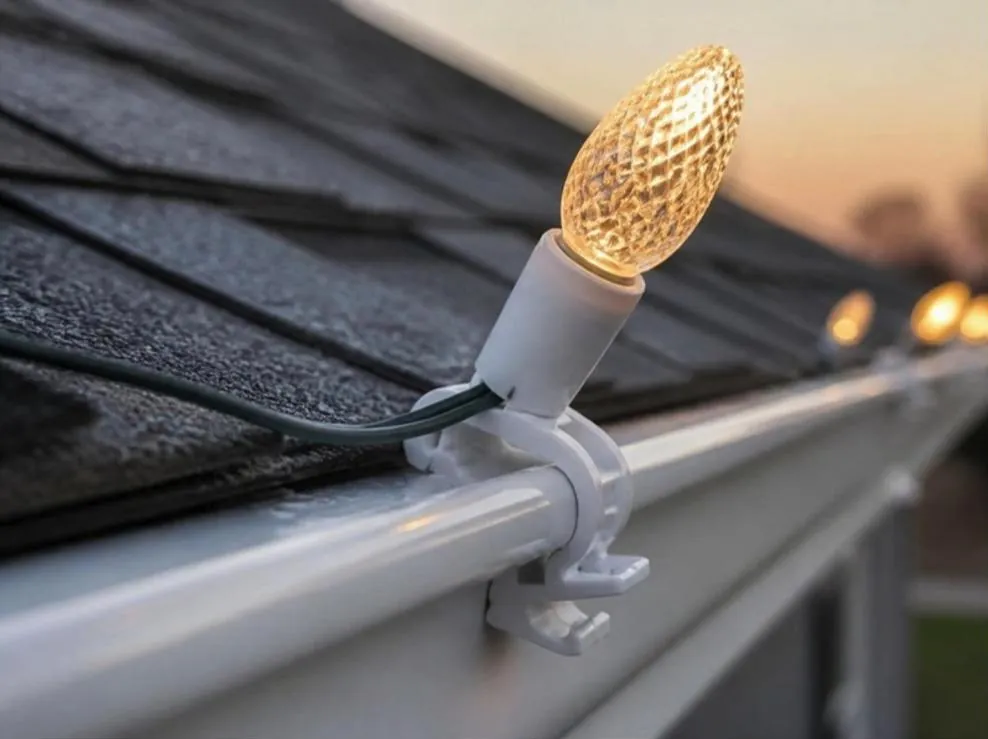
Yes, if they are rated for outdoor use, plugged into a GFCI-protected outlet, and the connections are kept off the ground. Rain and snow are normal for outdoor LED lights. Ice storms and high wind are the real test, because the weight and movement can pull lines loose or cut power, so check your display once the weather clears.
Are outdoor Christmas lights safe in rain and snow?
Yes, when they are made for it and installed right. Outdoor-rated lights are built to get wet. What causes trouble is water reaching plugs and connections, lights that were never meant for outdoor use, and outlets without ground-fault protection.
How do you know if lights are rated for outdoor use?
Read the label or package. The CPSC advises checking labels before using lights outdoors to make sure they are certified for outdoor use. Indoor strings are not built to handle water, even under a porch roof.
Some lights and plugs also list an IP rating. That is the next thing to understand.
What does an IP rating mean on Christmas lights?
An IP (ingress protection) rating tells you how well something keeps out dust and water. The ratings come from the international standard IEC 60529, and a two-digit code like IP65 breaks down this way, as summarized in this IP rating chart:
- First digit: solids and dust. A 5 means dust-protected (some dust can enter but not enough to interfere). A 6 means dust-tight.
- Second digit: water. A 4 means protected from splashing water from any direction. A 5 means protected from water jets. A 7 means protected from temporary immersion up to 1 meter.
| Rating | What it means | What it handles |
|---|---|---|
| IP44 | Protected from small objects and splashing water | Rain on a protected surface. Keep connections off the ground. |
| IP65 | Dust-tight, protected from water jets | Driving rain on a roofline or exposed run |
| IP67 | Dust-tight, protected from temporary immersion | Puddles and melting snow around ground-level connections |
Not every outdoor string lists an IP code. If yours doesn't, the outdoor label and the manufacturer's instructions are what to follow.
Why do sealed sockets and raised connections matter?
Because the bulbs are rarely the problem. The weak points are where things connect: plug to plug, string to extension cord, cord to outlet.
- Sealed sockets keep water out of the point where the bulb meets the wire. Check that every bulb is seated all the way down so the seal can do its job.
- Connections off the ground. Plugs sitting in a low spot fill with water when it rains and sit in slush when snow melts. Clip them up on the gutter, a downspout bracket or a stake.
- Drip loops. Let the cord dip slightly below the connection so water runs off the low point instead of into the plug.
- Covered connections. Weatherproof covers for plug connections add protection in exposed spots.
- Lines cut to fit. Extra strand bunched at a corner traps water and catches wind.
Do outdoor Christmas lights need a GFCI outlet?
Yes. The CPSC recommends plugging outdoor lights and decorations into circuits protected by ground-fault circuit interrupters (GFCIs), which protect against electric shock.
A GFCI cuts power when current leaks somewhere it shouldn't, such as through water. If your lights shut off every time it rains, the GFCI is usually doing its job and pointing you to a wet connection. Resetting it over and over without fixing the connection is not the answer.
What do ice storms and wind do to Christmas lights?
They add weight and movement, which pulls on clips and connections. Wind works a loose line back and forth until something gives. Ice coats the line, the clips and the gutter, and the extra weight can pull sections loose or crack brittle plastic.
The bigger issue in an ice storm is usually power. The Ozarks know this well. In the January 12 to 14, 2007 ice storm, the National Weather Service in Springfield, Missouri recorded one and a half inches of ice accumulation at its office, and approximately 200,000 residences in southwest Missouri lost power, some for days or weeks. The NWS noted outages on that scale had not happened since the December 1987 ice storm.
No display is designed to ride out a storm like that untouched. What good installation does is limit the damage:
- Secure fastening. The CPSC advises fastening outdoor lights securely to firm supports to protect them from wind damage.
- Even clip spacing so no single clip carries a long span.
- No loose extra strand to act like a sail.
- Connections up high and protected so meltwater doesn't reach them.
Does snow hurt LED Christmas lights?
Usually not. Snow covers the bulbs and dims them until it slides or melts off, but outdoor-rated LEDs are built for cold and wet. ENERGY STAR notes that LED strings have no filaments or glass, which makes them more durable and shock-resistant.
The risk with snow is to people. Don't climb onto a snowy or icy roof to clear lights, and don't knock ice off lines with a broom or pole.
What should you do if your lights go out after a storm?
Check the simple things from the ground first, then call for help if a section is down.
- Is the house power on? If the whole street is dark, the lights will come back with the power.
- Check the GFCI. If it tripped, look for a wet or damaged connection before resetting.
- Check the timer. A power outage can reset some timers to the wrong time.
- Look along the roofline from the yard. Note any section hanging loose or dark.
- Stay off the roof and away from power lines. Treat any downed line as live and call your utility.
If we installed your lights, just text or call us. If any section goes out during the season, we fix it within 48 hours, free. Weather that makes the roof unsafe can add a day, because we won't put a crew on an icy roof. Our article on two-story and steep roofs explains why roof conditions matter so much, and the injury data shows why we don't rush it.
Want lights that handle the weather?
We design, hang, fix, take down and store your lights, using commercial-grade LEDs cut to fit your roofline. If you are wondering whether there is still time this year, see booking late in the season. Send your address for a free picture of your home lit up with a custom quote in about 15 minutes. If you are outside our current area, send it anyway and we'll tell you straight whether we can reach you.
Common questions
Should I unplug my Christmas lights during a storm?
You don't need to for ordinary rain or snow if the lights are outdoor-rated and on a GFCI. During a lightning storm or a major ice storm, turning them off is a reasonable precaution.
Why does my GFCI keep tripping when it rains?
Water is usually reaching a plug, connection or damaged cord. Find the wet connection, dry it, raise it off the ground or cover it, and replace any damaged string.
Should I knock snow or ice off the lights?
No. Hitting brittle, iced-over lines and clips can break them. Let them melt off, and stay off the roof until it is clear.
Can I use indoor lights outside if they are under a porch roof?
Use only lights labeled for outdoor use outside. Covered porches still get wind-driven rain and condensation.