Home / Blog / Roof and safety
How Christmas lights go up on two-story homes and steep roofs
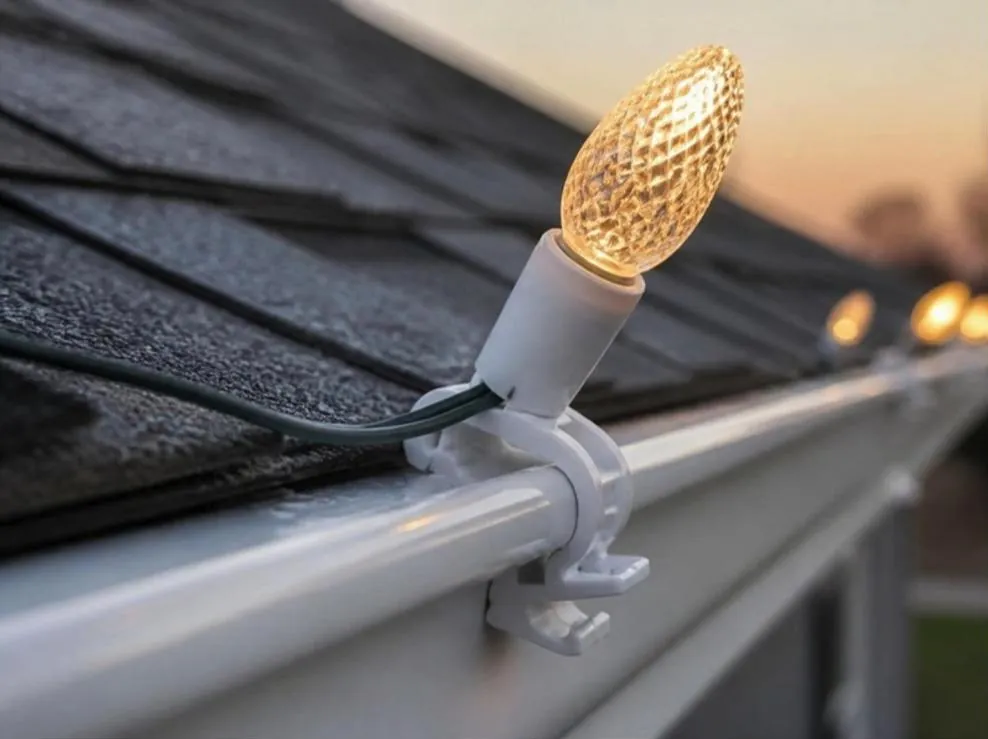
Two-story and steep roofs are lit mostly from the ladder, not by walking the roof. The ladder base goes about 1 foot out for every 4 feet of height and extends about 3 feet past the edge, and steeper pitches (roughly 8/12 and up) are treated as not walkable. Height and pitch add setup time, which is why they affect the price.
How do pros hang Christmas lights on two-story and steep roofs?
Mostly from a properly set ladder, with as little roof walking as possible. On a tall or steep house, the work is planned around where the ladder can stand safely, and the light layout follows from that.
Here is what that looks like in practice, from ladder angle to roof pitch to how peaks get lit.
What is the 4-to-1 ladder rule?
For every 4 feet of height to where the ladder rests, the base goes about 1 foot out from the wall. OSHA's ladder standard for construction work, 29 CFR 1926.1053, requires non-self-supporting ladders to be set so the horizontal distance at the base is about one-quarter of the ladder's working length. That works out to an angle of roughly 75 degrees.
Some quick examples:
- Gutter at 10 feet: base about 2.5 feet out.
- Gutter at 20 feet: base about 5 feet out.
- Peak contact point at 24 feet: base about 6 feet out.
Too steep and the ladder can tip backward when you lean out. Too flat and the base can kick out. The same OSHA standard says ladders go only on stable, level surfaces unless secured, and that a ladder used to reach a landing should extend at least 3 feet above it.
OSHA rules apply to employers, not homeowners. The geometry is the same for anyone on a ladder, though.
What is a ladder standoff, and why use one?
A standoff is an attachment that holds the top of the ladder away from the gutter and rests it on the wall or roof instead. It keeps the ladder's weight off the gutter, which can bend, and gives a wider, steadier contact point.
It also puts the installer's hands right at the gutter lip, where gutter clips go, instead of behind it. On two-story homes with deep eaves or soft aluminum gutters, a standoff is often the difference between a solid setup and a wobbly one.
Other ladder gear that matters on tall homes
- Leg levelers for sloped yards and uneven ground near foundations.
- Non-slip feet or spikes chosen for the surface: concrete, mulch or turf.
- A second person at the base, especially for the first and last climb of each section.
- Nonconductive (fiberglass) rails anywhere near the overhead power line to the house. OSHA's ladder standard requires nonconductive side rails where a worker or ladder could contact exposed energized electrical equipment.
What does roof pitch mean?
Pitch is how many inches a roof rises for every 12 inches it runs horizontally. This Old House explains that a 6/12 pitch rises 6 inches over 12 inches of run, and that most residential roofs fall between 4/12 and 8/12.
OSHA's fall protection rules define a low-slope roof as 4/12 or less and a steep roof as anything greater than 4/12. So by OSHA's definition, most houses have steep roofs.
What does "walkable" mean?
There is no single legal definition, but roofers generally treat walkability as a judgment call that gets harder past about 6/12. The InspectAPedia roof slope table describes 7/12 as walkable with caution and 8/12 as a pitch where walking is not advised. Frost, dew, loose granules and leaves make any pitch worse.
| Roof pitch | What it means | How lights usually go up |
|---|---|---|
| 4/12 or less (about 18 degrees or less) | Low slope. Comfortable to stand on when dry. | Ladder to the gutter line. Short roof walks for ridges when dry. |
| 5/12 to 6/12 (about 23 to 27 degrees) | Common on ranch and two-story homes. Walkable for experienced people in dry conditions. | Mostly from the ladder. Limited roof time, never on frost or dew. |
| 7/12 (about 30 degrees) | Steep. Walkable with caution. | Ladder work for edges and gables. Roof access only with fall protection planned. |
| 8/12 and up (about 34 degrees and up) | Walking not advised. | Light from ladders at eaves and gables. Peaks reached from the gable end, or the design adjusted. |
| 12/12 (45 degrees) | Very steep, common on some gables and dormers. | Edges from the ladder only. Anything that needs roof access is planned case by case. |
The degree figures are simple conversions of rise over run. They are there so you can picture the slope.
What fall protection does a steep roof call for?
For work crews, OSHA's rule is that anyone on a steep roof with unprotected edges 6 feet or more above a lower level must be protected from falling. Under 29 CFR 1926.501, that means guardrails, safety nets or personal fall arrest systems (a harness tied to an anchor). The standard has a separate section for residential construction with the same 6-foot trigger, and it allows a written fall protection plan where those systems are infeasible or create a greater hazard.
How the standard applies to a given job is something each company works out with its crew and safety advisers. For a homeowner, the takeaway is simpler: if your roof is steep enough that professionals tie off on it, it is not a roof to walk on with a box of clips in one hand.
How do you light peaks and gables safely?
Usually from a ladder set at the gable end, working up the rake edge toward the peak. The rake is the sloped edge of the roof on a gable, and lights follow it with clips under the shingle edge or along the drip edge.
- Lay out the line on the ground first. Each run is measured and cut to fit, so there is no extra strand to wrestle at the top.
- Work from the eave up. Clip the lower part of the rake from a ladder position at the corner.
- Move the ladder rather than reaching. Each move is a few minutes. A fall is not.
- Reach the peak from the gable. On a tall gable, the ladder rests against the wall near the peak, often with a standoff.
- Adjust the design where a section can't be reached safely. A clean line on the reachable edges looks better than a crooked one at the very top.
Why does height affect the price?
Because the time goes into setup, not lights. Every ladder move on a two-story home takes longer: a taller ladder, more careful footing, a standoff, a second person. Steep pitches add more ladder positions because less work can be done from the roof.
That is why our quotes are built from feet of roofline plus home height and roof access. Our article on what drives the price explains the rest, and our injury data article covers why ladder setup matters so much.
Have a tall or steep house?
We design, hang, fix, take down and store your lights, and we plan the install around your roof. Send your address and we trace your roofline from satellite, then text you a picture of your home lit up with a custom quote in about 15 minutes. If you are outside our current area, send it anyway and we'll tell you straight whether we can reach you.
Common questions
How tall a ladder do I need for a two-story gutter?
Measure from the ground to the gutter, then add enough for the proper angle and about 3 feet of extension above the edge. Extension ladders are rated by total length, and the usable height is shorter than that number.
Can you light a roof peak without walking the roof?
Often, yes. Many peaks can be reached from a ladder set at the gable, sometimes with a standoff. Where that is not possible, the plan changes before anyone climbs.
How do I find my roof pitch?
Your roofer or home inspection report may list it. You can also measure on a gable end: how many inches the roof rises over 12 inches of horizontal run.
Can a three-story home be lit?
Often, but it depends on the roof, the ground around the house and what can be reached safely. Send your address and we will tell you straight what we can light.
Do you need to go inside to plug in on a two-story home?
Not usually. Most displays run from an outdoor outlet.