Home / Blog / Cost and leasing
How much electricity do LED Christmas lights use?
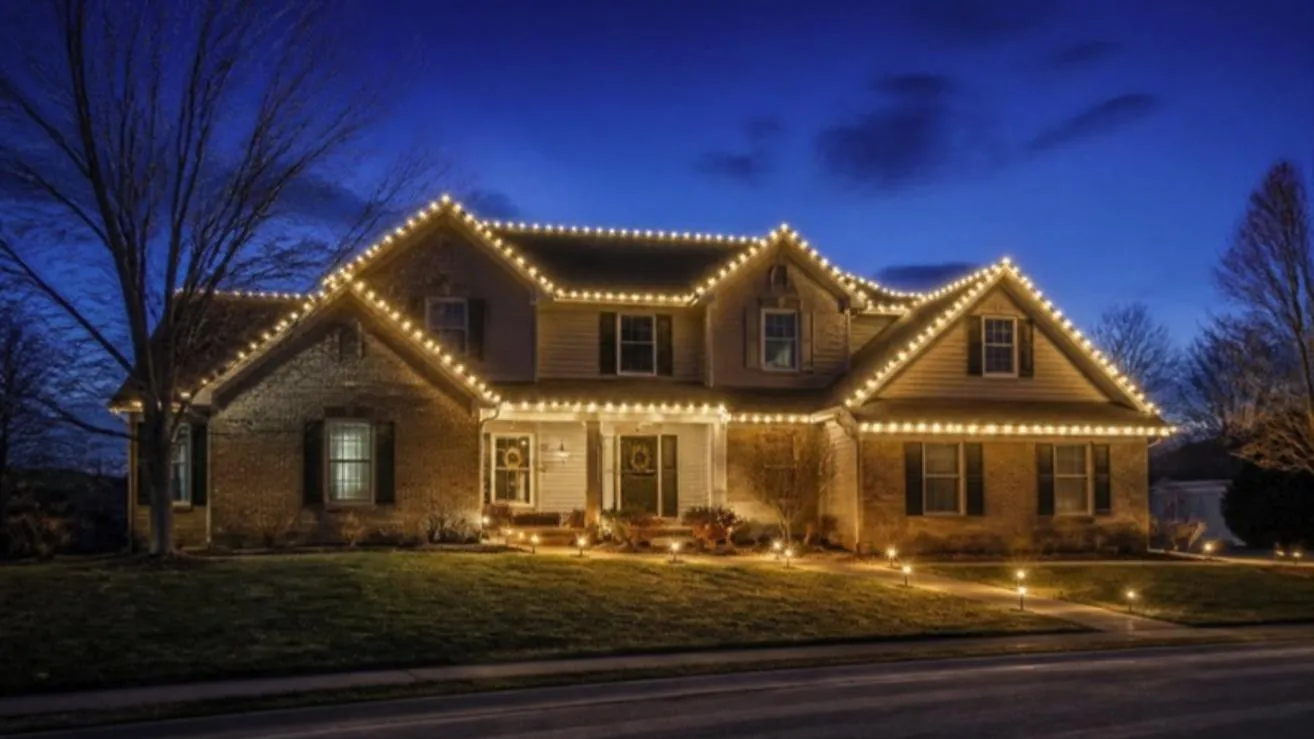
Very little. A 150-foot roofline of LED C9 bulbs at about 0.5 watts each uses around 75 watts, or about 18 kWh for a 40-night season at 6 hours a night. The same roofline in 7-watt incandescent C9s would use about 252 kWh. Multiply the kWh by the rate on your utility bill to see what it means for you.
Do LED Christmas lights raise your electric bill?
A little, but much less than most people expect. A typical LED roofline on a timer uses less electricity over the whole season than an average U.S. household uses in a single day, while the same display in old incandescent bulbs uses more than ten times as much.
Below is the math in watts and kilowatt-hours (kWh), the unit your utility bills you in. We leave out rates on purpose, because they vary by utility and by season. Once you have the kWh, multiply it by the per-kWh rate printed on your bill.
How much less energy do LED Christmas lights use?
About 90% less, according to the government programs that test them. ENERGY STAR says certified LED light strings use approximately 92% less energy than conventional incandescent strings and can last up to 10 times longer. ENERGY STAR's certification limit is no more than 0.2 watts per bulb.
Natural Resources Canada's ENERGY STAR page gives a slightly more conservative number: LED strings use 75% less energy on average, and single-color LED strings up to 90% less. Both programs use the same example: the electricity one 7-watt incandescent bulb uses could power 140 LEDs.
What about the big C9 and C7 bulbs on a roofline?
Rooflines usually use C9 or C7 bulbs, which are larger than mini lights. Lighting retailer 1000Bulbs lists incandescent C9s at 7 watts (with a range of 7 to 10) and incandescent C7s at 5 watts (a range of 5 to 7). Its LED C9 and C7 bulbs are listed at about 0.5 watts each, with some LED models up to about 0.74 watts. If you want to know more about the bulb sizes themselves, see C9 vs. C7 vs. mini lights.
How do you work out kWh for your Christmas lights?
Multiply watts by hours, then divide by 1,000. That gives you kilowatt-hours.
- Find the watts. Add up the watts for every bulb or string. The label or box lists watts per string or per bulb.
- Multiply by hours per night. Use your timer schedule.
- Multiply by the number of nights.
- Divide by 1,000. Now you have kWh for the season.
- Multiply by your rate. Use the per-kWh rate on your utility bill. If your utility charges different rates at different times of day, use the evening rate.
What does a typical roofline use in a season?
Here is a worked example for a common one-story or modest two-story roofline. Change any assumption to match your house.
Assumptions
- 150 feet of roofline, lit with C9 bulbs spaced 12 inches apart, so 150 bulbs.
- LED C9 at 0.5 watts per bulb, and incandescent C9 at 7 watts per bulb, using the figures above.
- 6 hours a night on a timer, for example 5 p.m. to 11 p.m.
- 40 nights, roughly the start of December into early January.
The math
- LED: 150 bulbs × 0.5 watts = 75 watts. 75 watts × 6 hours = 450 watt-hours, or 0.45 kWh a night. Over 40 nights: 18 kWh.
- Incandescent: 150 bulbs × 7 watts = 1,050 watts. 1,050 watts × 6 hours = 6.3 kWh a night. Over 40 nights: 252 kWh.
For scale, the U.S. Energy Information Administration says the average residential customer used about 899 kWh a month in 2022. The LED roofline above is about 2% of one average month. The incandescent version is closer to 28%.
| LED C9 | Incandescent C9 | |
|---|---|---|
| Watts per bulb | About 0.5 | About 7 |
| Watts for 150 bulbs | 75 | 1,050 |
| kWh per night (6 hours) | 0.45 | 6.3 |
| kWh per season (40 nights) | 18 | 252 |
| Share of an average month (899 kWh) | About 2% | About 28% |
| Heat | Cool to the touch | Hot bulbs |
| Strings safely connected end to end | Per the label, usually many | CPSC advises no more than three sets |
The last two rows come from safety guidance. ENERGY STAR notes that certified LED strings are cool to the touch, which reduces fire risk. The CPSC advises not connecting more than three sets of incandescent lights.
What about trees, bushes and other add-ons?
Add their watts to the total the same way. Wrapped trees and bushes usually use mini lights, and under the ENERGY STAR limit of 0.2 watts per bulb, a tree wrapped with 500 certified LED minis would draw at most 100 watts. At 6 hours a night for 40 nights, that is at most 24 kWh. Spotlights and uplights list their watts on the fixture.
So the LED roofline above plus two wrapped trees would draw at most 275 watts, or at most 66 kWh over the season. That is still well under a tenth of one average month. Our guide to HOA rules covers hours limits if your community sets a cutoff time, which also trims kWh.
How do you keep holiday lighting kWh low?
Use LEDs, use a timer, and don't light hours nobody is watching. Those three choices matter far more than anything else.
- Put everything on a timer. The CPSC recommends turning holiday lights off when you go to bed or leave the house. A timer does that for you every night.
- Pick sensible hours. Dusk to 10 or 11 p.m. covers the time neighbors and drivers actually see the lights. Running until morning doubles or triples the hours.
- Replace old incandescent strings in the yard too. One old incandescent string on a bush can use more than an entire LED roofline.
- Check the label. Most strings and bulbs list watts on the label or box. That number is all you need for the math above.
Is the electricity worth worrying about?
For an LED display on a timer, usually not. The bigger questions are safety, how it looks, and who handles the ladder work, which we cover in pro install vs. DIY.
If you want an exact kWh figure for your home, count bulbs, use the watts on the label, and run the five steps above with your timer schedule and your utility's rate.
Want LED lights without the guesswork?
We supply commercial-grade LED lights cut to fit your roofline, put them on a timer, fix any section that goes out within 48 hours, then take everything down in January and store it. Send your address and we'll text you a picture of your home lit up with a custom quote in about 15 minutes. If you are outside our current area, send it anyway and we'll tell you straight whether we can reach you.
Common questions
Do LED Christmas lights use more power when it is cold?
The label lists the watts the string is rated to draw, and that is the number to use. Cold weather does not turn a 0.5-watt bulb into a 7-watt one.
Is it cheaper to leave lights on all night or use a timer?
A timer always uses less, because kWh is simply watts times hours. Every hour the lights are off is an hour they use nothing.
Do multicolor LEDs use more electricity than warm white?
Not by enough to matter for a typical home. Check the watts printed on the package or label if you want the exact figure.
Can I run my lights on the same outlet as other things?
Yes, within the circuit's rating. LEDs draw so little that a whole roofline usually fits on one outdoor circuit, but anything else on that circuit counts too.
Does a smart timer use electricity?
A small amount to stay connected. It is far less than the hours of lighting it saves by shutting the display off on schedule.