Home / Blog / Design ideas
How to light trees and bushes for Christmas: wraps, drapes, nets and uplights
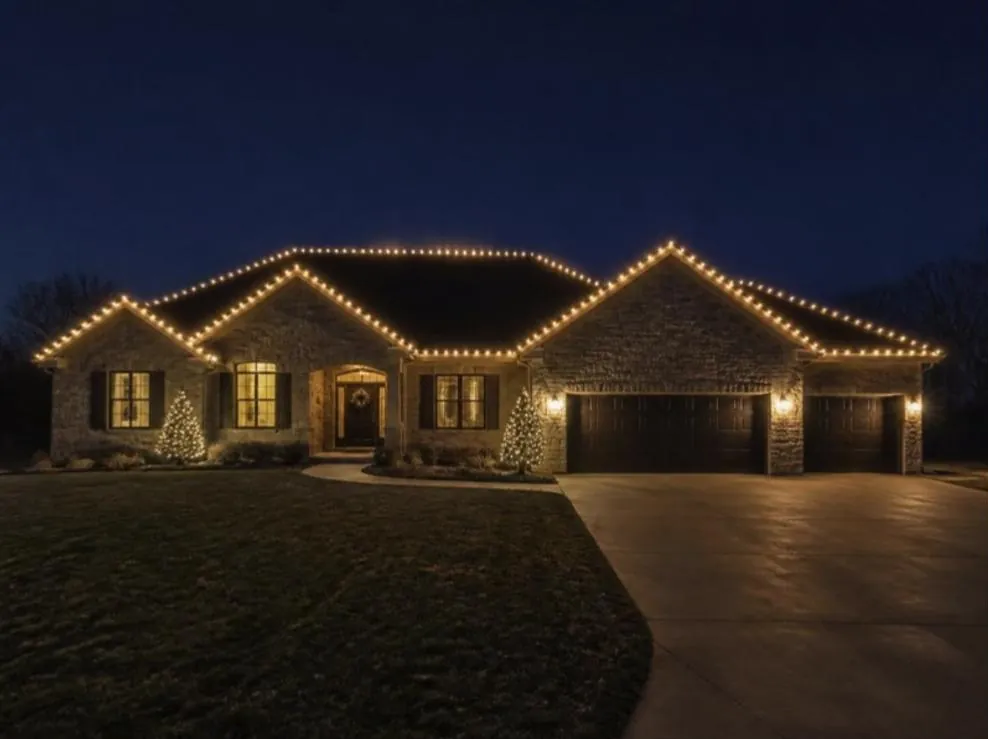
Small and medium deciduous trees look best with a tight trunk wrap, plus branch wraps if you want them to glow. Evergreens and large trees are usually draped or uplit, and round shrubs are fastest and most even with net lights. Pick the method by the plant's shape and how far it sits from the street.
What is the best way to put Christmas lights on trees and bushes?
The best method depends on the plant: wrap trunks and branches on deciduous trees, drape or uplight evergreens and big trees, and use net lights or a loose wrap on shrubs. Each method gives a different look, and the wrong one can make a nice tree look sparse or messy.
Here is how each method works, then which plant gets which.
What are the main ways to light a tree?
There are four: trunk wrap, canopy (branch) wrap, drape, and uplight. Most great yard displays use two or three of them across different trees.
Trunk wrap
Mini lights wind up the trunk in a tight spiral, from the ground to where the main branches split. It is clean, bright and reads well from the street, especially on bare winter trees. The Christmas Light Emporium suggests about 3 to 4 inches between rows on a trunk for a dense, polished look.
Canopy (branch) wrap
The wrap continues out along the main branches, so the whole tree glows in its natural shape. It takes much more light and time than a trunk wrap (the same guide says 1.5 to 2 times the trunk amount) and looks best on trees with a strong branch structure. Branches usually get a looser spacing of 6 to 8 inches.
Drape
Strands hang from the top of the tree down over the outside branches, like a Christmas tree indoors. This is the quickest way to light an evergreen and it keeps the tree's cone shape. On very tall trees, draping is often limited to what can be reached safely.
Uplight
A spotlight sits at the base and washes light up into the tree. It is the right tool for big trees that are too tall or too wide to wrap, and for evergreens where you want a soft glow instead of points of light. One or two fixtures can light a tree that would take hours to wrap.
Which method works for which plant?
| Plant type | Best method | Bulb | Tip |
|---|---|---|---|
| Small deciduous tree (crepe myrtle, Japanese maple, redbud) | Trunk wrap plus branch wraps | Mini | Smooth bark needs a few clips to keep the wraps from sliding. |
| Medium deciduous tree (Bradford pear, young oak or maple) | Trunk wrap, branch wraps on the lower main limbs | Mini | Stop where a ladder can safely reach, and let the shape do the rest. |
| Large shade tree (mature oak, sycamore) | Trunk wrap plus uplight | Mini on trunk, spotlight below | The uplight fills the canopy the wrap can't reach. |
| Evergreen tree (pine, cedar, spruce, holly tree) | Drape or uplight | Mini or C9 | Dense needles hide wraps, so light the outside. |
| Round shrubs (boxwood, holly, yew) | Net lights | Mini (net) | Fastest way to get even coverage. |
| Irregular or tall shrubs | Loose wrap or drape | Mini | Follow the shape, don't force a net over it. |
| Palm or single-trunk ornamental | Trunk wrap | Mini | Tight, even rows make the trunk read as a column of light. |
How does tree size change the approach?
The bigger the tree, the more you rely on wrapping the trunk and lighting the canopy from below, because the top is out of safe reach. Small trees can be wrapped almost completely. Medium trees get the trunk and the lower main branches. Large trees get a trunk wrap and an uplight, and maybe a drape on the lowest limbs.
Distance matters too. A tree 15 feet from the sidewalk can carry fine detail. A tree 80 feet back from the road needs bold coverage or it disappears at night. That is one reason C9 bulbs sometimes go on large trees: they read from farther away. We compare bulb sizes in C9 vs C7 vs mini Christmas lights.
Deciduous or evergreen: does it matter?
Yes, a lot. Deciduous trees are bare in December, so a wrap shows every branch and the lights become the whole shape of the tree. Evergreens keep their needles, so wraps get buried inside. That is why evergreens look best draped or uplit on the outside.
Bark matters as well. Smooth-bark trees like crepe myrtles and maples can let wraps slip, so they need a few clips to hold the spacing (the same guide suggests every 12 to 18 inches). Rough bark on mature oaks and elms usually grips the wire without help.
When should you use net lights on bushes?
Use net lights on round or boxy shrubs that are roughly waist high or shorter. A net lays over the top in one piece and gives an even grid of light, which is hard to match by hand-wrapping a dense boxwood. Tuck the edges under so the net follows the shape, and use matching sizes so a row of shrubs looks uniform.
Skip nets on tall, open or irregular shrubs. They look like a blanket thrown over the plant. A loose wrap that follows the branches looks more natural there.
How do you keep trees healthy under the lights?
Wrap snug, not tight, and take the lights off after the season. The tree care company Davey advises against lighting a young, newly planted tree or one that is weak or damaged, and recommends removing tree guards or burlap wraps before hanging lights. Nails and staples never go into a tree.
Lights left up year-round on a growing tree can cut into the bark as the branches thicken. Our lights come down in January with everything else, so nothing stays on the tree.
How do you run cords across the lawn?
Plan the power before you plan the look, because cord runs decide what is practical. A tree in the middle of the lawn needs a cord from the nearest outdoor outlet, and that cord has to stay safe and out of the way all season.
- Use outdoor-rated cords and GFCI outlets. The Electrical Safety Foundation recommends that outdoor cords and decorations be marked for outdoor use and plugged into GFCI-protected circuits.
- Follow edges. Run cords along beds, fences and walkway edges rather than straight across open grass.
- Keep connections off the ground. Plugs sitting in standing water or snow are a common cause of tripped outlets.
- Avoid mower and foot paths. A cord across the middle of the lawn gets stepped on and caught.
- Don't overload one outlet. Spread trees and bushes across circuits when you can.
LED minis draw very little power, so even a yard full of wrapped trees adds less to the bill than most people expect. We break that down in do LED Christmas lights raise your electric bill.
How many trees should you light?
Start with the trees and shrubs closest to the front walk and the street, then stop when the yard feels balanced with the roofline. One or two fully wrapped trees near the entry usually do more than a half-wrapped trunk on every tree in the yard. If you are weighing doing it yourself, ladder work in trees has the same risks as roof work, which we cover in professional installation vs DIY.
Want help choosing which trees to light?
Trees, bushes and shrubs are add-ons we design alongside your roofline, then hang, fix during the season, take down in January and store. Send your address and we will text back a picture of your home lit up, trees included, with a custom quote in about 15 minutes. If you are outside our current area, send your address anyway and we'll tell you straight whether we can reach you.
Common questions
Will wrapping lights hurt my tree?
Not if the lights go on snug, not tight, and come off at the end of the season. Wire left on for years can cut into a growing branch, which is why everything comes down in January.
Can you light a tree in the middle of my yard?
Yes. It needs an outdoor-rated cord from the nearest outlet, kept along beds and edges where possible.
Should trees match the roofline color?
They can match or contrast. A warm white roofline with warm white trees looks calm and classic, and a warm white roofline with multicolor trees looks playful.
Do I need to light every tree?
No. One or two well-lit trees near the front walk usually look better than every tree done halfway.